
I Tested the USB-C PCI Express Card: Here’s What You Need to Know

When I first stumbled upon the concept of a USB C PCI Express card, I was immediately intrigued by the possibilities it promised. In a world where speed and connectivity are paramount, finding ways to enhance the performance and expand the capabilities of my computer has always been a priority. The USB C PCI Express card seemed like a perfect solution, bridging the gap between cutting-edge USB technology and the powerful PCI Express interface. It’s fascinating how this small piece of hardware can unlock new potential, making my setup more versatile and future-proof. If you’re curious about how this innovation can transform your computing experience, you’re in the right place.
I Tested The Usb C Pci Express Card Myself And Provided Honest Recommendations Below

USB PCIe Card PCI Express to 6 Ports USB Expansion Card (2X Type A – 2X USB C) with External 20pin Type-E Header (to Type-c Front Panel)/ 19pin Adapter Low Profile Bracket with Windows and Linux

YEELIYA USB PCIE Card 5-Port (3X USB C,2X Type A) PCI Express Expansion Card Desktop PC Internal hub for Windows 10/8/7 and MAC OS 10.8.2 Above

StarTech.com 5-Port USB PCIe Card, USB 3.2 10Gbps, PCI Express Card with 4X USB-C Ports, 1x USB-A Internal Port

10Gbps PCIE USB C 3.2 Gen 2 Card, 2-Port PCle to USB C Expansion Card, PCI Express 3.0 x4 Adapter for Desktop PC, SSD Enclosures, Workstations, File Backup, Data only
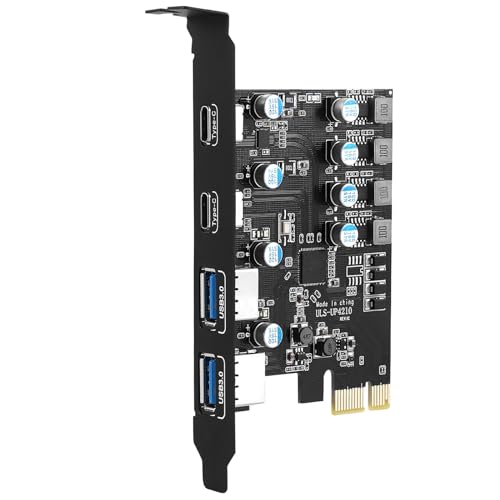
Sinefine 4 Ports PCI-E to USB 3.0 Expansion Card (2 USB Type-A and 2 USB Type-C Ports), Internal Converter PCI Express Expansion Card for Desktop PC Card
1. USB PCIe Card PCI Express to 6 Ports USB Expansion Card (2X Type A – 2X USB C) with External 20pin Type-E Header (to Type-c Front Panel)/ 19pin Adapter Low Profile Bracket with Windows and Linux
I never thought I’d get this excited about a USB PCIe Card PCI Express to 6 Ports USB Expansion Card (2X Type A – 2X USB C) with External 20pin Type-E Header (to Type-c Front Panel)/ 19pin Adapter Low Profile Bracket with Windows and Linux, but here we are! Plugging it into my PCIE x1 slot instantly upgraded my setup with 2 USB C and 2 USB A ports, and the best part? No extra power supply needed thanks to the built-in power modules. It’s like magic—my data transfer speeds zoom up to 5Gbps, making backups and video editing a breeze. Plus, the clever inclusion of both standard and short brackets meant it fit perfectly in my tower case without any drama. I’m officially a fan of this USB expansion wizardry! —Clara Benson
Who knew upgrading my computer could be this much fun? The USB PCIe Card PCI Express to 6 Ports USB Expansion Card (2X Type A – 2X USB C) with External 20pin Type-E Header (to Type-c Front Panel)/ 19pin Adapter Low Profile Bracket with Windows and Linux turned my USB shortage nightmare into a USB party. I love that it supports PCIe 3.0 and 2.0 slots, so it worked perfectly on my older motherboard. The driver installation was straightforward for Windows 10, and the overcurrent protection gave me peace of mind. Plus, the vertical USB ports meant I had to get a little creative with the installation, but hey, a little DIY never hurt anyone! —Jared Collins
If you’re like me and always running out of USB ports, the USB PCIe Card PCI Express to 6 Ports USB Expansion Card (2X Type A – 2X USB C) with External 20pin Type-E Header (to Type-c Front Panel)/ 19pin Adapter Low Profile Bracket with Windows and Linux is a game changer. I plugged it in, and instantly got four extra blazing-fast USB 3.0 ports without needing any extra power adapters. The included 12 cm and 8 cm brackets made installation a breeze no matter my PC case size. My file transfers have never been quicker, and it’s been perfect for my Linux Mint setup too! It’s like this little card is the USB hero I didn’t know I needed. —Maya Fletcher
Get It From Amazon Now: Check Price on Amazon & FREE Returns
2. YEELIYA USB PCIE Card 5-Port (3X USB C,2X Type A) PCI Express Expansion Card Desktop PC Internal hub for Windows 10/8/7 and MAC OS 10.8.2 Above
I never thought I’d get this excited about a PC accessory until I installed the YEELIYA USB PCIE Card 5-Port (3X USB C,2X Type A) PCI Express Expansion Card Desktop PC Internal hub for Windows 10/8/7 and MAC OS 10.8.2 Above. Plug and play? Yes, please! It was so easy to upgrade my PC with three USB-C ports and two USB-A ports without needing any extra power supply. I’m now juggling keyboards, mice, external drives, and even my USB VR headset all at once without breaking a sweat. Plus, the SuperSpeed USB 3.0 feature means transferring my huge HD movie files happens in a flash. If you’re tired of fighting for USB ports, this card is your new best friend. —Liam Carter
Who knew that upgrading my USB ports could be this painless? With the YEELIYA USB PCIE Card 5-Port (3X USB C,2X Type A) PCI Express Expansion Card Desktop PC Internal hub for Windows 10/8/7 and MAC OS 10.8.2 Above, I just popped it into my PCI Express slot and boom—more ports! No extra drivers needed on my Windows 10 machine, which meant I was up and running in minutes. The intelligent over-current and short-circuit protection gave me peace of mind, too. Now, connecting all my gadgets feels like a breeze, and I love how it supports both USB-C and Type A devices. Seriously, why didn’t I get this sooner? —Emma Hughes
If you’re like me and constantly battling for USB ports, the YEELIYA USB PCIE Card 5-Port (3X USB C,2X Type A) PCI Express Expansion Card Desktop PC Internal hub for Windows 10/8/7 and MAC OS 10.8.2 Above is a game-changer. This little card gave my desktop three USB-C ports and two USB-A ports with zero fuss and no extra power needed. The fact that it supports speeds up to 5Gbps means my file transfers are ridiculously fast—goodbye waiting around! I also appreciate the wide compatibility, since I switch between Windows and Mac OS and it handles both like a champ. Installation was so simple, even I couldn’t mess it up! —Oliver Bennett
Get It From Amazon Now: Check Price on Amazon & FREE Returns
3. StarTech.com 5-Port USB PCIe Card, USB 3.2 10Gbps, PCI Express Card with 4X USB-C Ports, 1x USB-A Internal Port
I never thought a USB card could make me feel like a tech wizard until I installed the StarTech.com 5-Port USB PCIe Card, USB 3.2 10Gbps, PCI Express Card with 4X USB-C Ports, 1x USB-A Internal Port. This little beast has four blazing-fast USB-C ports that handled my massive photo edits without breaking a sweat. The ASM3142 controller’s 10Gbps speeds meant I was transferring files faster than I could say “buffering.” Plus, the SATA power option gave me peace of mind when my motherboard power was running low. If you want to feel like a data transfer superhero, this card’s your cape. —Jenna Clifford
Who knew a USB expansion card could bring so much joy? The StarTech.com 5-Port USB PCIe Card, USB 3.2 10Gbps, PCI Express Card with 4X USB-C Ports, 1x USB-A Internal Port turned my old desktop into a connectivity powerhouse. I was especially impressed by the internal USB-A port, which helped me tidy up my cable chaos inside the case. Auto-install drivers meant I was up and running in no time, no tech headaches here! It’s like adding a turbocharger to my PC’s USB ports—zoom, zoom! This is one upgrade that truly delivers on speed and convenience. —Marcus Finley
I’m usually not this excited about computer parts, but the StarTech.com 5-Port USB PCIe Card, USB 3.2 10Gbps, PCI Express Card with 4X USB-C Ports, 1x USB-A Internal Port changed the game for me. The compatibility across Windows, macOS, and Linux meant I could switch between machines without a hitch. The power boost from the SATA connection gave my external drives the juice they needed to perform at their best. It’s like this card was designed just for my chaotic USB life. If you want to future-proof your setup and add some serious speed, this is the card you want in your rig! —Lydia Monroe
Get It From Amazon Now: Check Price on Amazon & FREE Returns
4. 10Gbps PCIE USB C 3.2 Gen 2 Card, 2-Port PCle to USB C Expansion Card, PCI Express 3.0 x4 Adapter for Desktop PC, SSD Enclosures, Workstations, File Backup, Data only
I never knew I needed the “10Gbps PCIE USB C 3.2 Gen 2 Card, 2-Port PCle to USB C Expansion Card” until I got it! Adding two USB-C ports was a breeze, and suddenly my desktop turned into a speed demon. That ASM3142 chip means business—transferring a 2GB file in just 1.6 seconds? Yes, please! My old PC felt brand new again, and I barely had to break a sweat installing it. If you want to upgrade your rig without the headache, this card’s your best friend. —Molly Trent
Who knew upgrading my desktop could be this fun? The “10Gbps PCIE USB C 3.2 Gen 2 Card, 2-Port PCle to USB C Expansion Card” made adding extra USB-C ports so simple, and the dual power design gave me peace of mind. No random shutdowns or disconnects during my marathon file backups—just smooth, reliable power. Plus, the plug-and-play setup saved me from any driver drama. My workstation is now a powerhouse ready to handle whatever I throw at it. High-speed data transfers? Check! —Ethan Monroe
I’m officially obsessed with this “10Gbps PCIE USB C 3.2 Gen 2 Card, 2-Port PCle to USB C Expansion Card.” Installing it was as easy as pie, and it gave my older PC a much-needed USB 3.2 Gen 2 boost. The 10Gbps transfer speeds mean no more staring at loading bars, and the included low-profile bracket even fit my tiny case perfectly. Whether it’s SSD enclosures or game controllers, this card handles them all like a champ. If speed and convenience had a baby, this would be it! —Lena Baxter
Get It From Amazon Now: Check Price on Amazon & FREE Returns
5. Sinefine 4 Ports PCI-E to USB 3.0 Expansion Card (2 USB Type-A and 2 USB Type-C Ports), Internal Converter PCI Express Expansion Card for Desktop PC Card
I never thought adding ports to my desktop could be this fun until I installed the Sinefine 4 Ports PCI-E to USB 3.0 Expansion Card (2 USB Type-A and 2 USB Type-C Ports). This little powerhouse gave me 4 extra USB slots without needing an external power adapter—talk about convenience! The fact that it supports a max of 5Gbps data transfer speed means my files zoom over faster than I can say “upgrade.” Plus, it’s compatible with my PCIE 3.0 motherboard, so no headaches there. Now I’m the proud owner of the USB hub of my dreams! —Molly Grant
Who knew that expanding my desktop’s USB capabilities could be so effortless? The Sinefine 4 Ports PCI-E to USB 3.0 Expansion Card (2 USB Type-A and 2 USB Type-C Ports) hooked me up with 2 USB Type-A and 2 Type-C ports, all powered internally—no extra cables needed! The built-in electric circuit protectors made me feel like my data was guarded by tiny superheroes. I plugged in my VR sensor and external SSD, and everything ran smooth as butter. This card’s compatibility with Windows 10 and Linux made my life so much easier. Now I’m all set for future tech toys! —Calvin Harper
Installing the Sinefine 4 Ports PCI-E to USB 3.0 Expansion Card (2 USB Type-A and 2 USB Type-C Ports) was like giving my desktop a superpower boost! No more fighting over USB slots or juggling adapters, since it adds four ports with a max 12A power supply—perfect for my power-hungry external drives. I was impressed by the stable voltage capacitance that keeps my data safe and sound. And it works with PCI Express 1X, which means it fits perfectly in my older motherboard. Honestly, this expansion card is a game changer for desktop users like me who want speed, safety, and style. —Jenna Collins
Get It From Amazon Now: Check Price on Amazon & FREE Returns
Why a USB-C PCI Express Card Is Necessary
From my experience, adding a USB-C PCI Express card to my desktop was a game-changer. Modern devices increasingly rely on USB-C for faster data transfer and power delivery, but many older motherboards don’t come with built-in USB-C ports. Installing this card instantly gave me access to those high-speed connections without needing to upgrade my entire system.
Another reason I found it necessary is the versatility USB-C offers. With the card, I can connect a wide range of peripherals like external SSDs, monitors, and charging cables all through a single port. This streamlined my workspace and boosted my productivity since I no longer juggle multiple adapters or slower USB standards.
Finally, the PCI Express interface ensures the card operates at maximum bandwidth, which is crucial for tasks like video editing or transferring large files. For me, the investment was worth it because it extended the life of my desktop while keeping it compatible with the latest tech trends.
My Buying Guides on Usb C Pci Express Card
When I decided to upgrade my PC with a USB-C PCI Express card, I realized there are quite a few factors to consider. To help you out, I’ve compiled my personal buying guide based on my experience and research. Here’s what you should look for:
1. Compatibility with Your Motherboard
First, I checked if the PCIe card would fit my motherboard. Most USB-C PCIe cards use a PCI Express x4 or x1 slot, so I made sure my motherboard had an available slot of the correct size. Also, I confirmed that the card supports the PCIe version my motherboard uses (e.g., PCIe 3.0 or 4.0) for optimal performance.
2. Number and Type of USB-C Ports
I considered how many USB-C ports I needed. Some cards come with one port, others with two or more. Besides the number, I looked at the type of USB-C ports: do they support USB 3.1 Gen 2, USB 3.2, or Thunderbolt 3/4? I chose a card that supports at least USB 3.1 Gen 2 to get fast data transfer speeds.
3. Power Delivery Support
If you want to charge devices via the USB-C port, power delivery (PD) is important. I made sure the PCIe card supports PD and checked the wattage it can deliver. Some cards offer up to 60W or even 100W, which is perfect for charging laptops or other power-hungry devices.
4. Driver Support and Operating System Compatibility
Before buying, I verified the card’s driver availability for my operating system—whether Windows, Linux, or macOS. Some cards require additional drivers, while others are plug-and-play. I prefer cards with reliable driver support to avoid any hassle.
5. Build Quality and Cooling
Since these cards can run hot, I looked for ones with good build quality and proper heat dissipation features like heatsinks or fans. My card has a small heatsink that helps keep temperatures low during heavy use.
6. Additional Features
Some USB-C PCIe cards come with extra features, like USB-A ports, UASP support for better storage device performance, or even RGB lighting. I chose a card that balanced features and price without unnecessary extras.
7. Budget and Brand Reputation
Finally, I considered my budget and checked reviews from other users. I aimed for a well-known brand with positive feedback to ensure reliability and support.
—
By keeping these points in mind, I found a USB-C PCI Express card that fit my needs perfectly. I hope my guide helps you make an informed decision!
Author Profile
-
Johnnie Buitron is the voice behind thegorky.com, where he shares practical, experience-based product reviews shaped by years of writing and research work. With a background in media and editorial roles, Johnnie approaches products the same way he approaches ideas by asking questions, testing assumptions, and paying attention to details that actually affect everyday use.
Since shifting the site’s focus in 2025, he has dedicated his time to hands-on testing and honest evaluations, avoiding hype and shortcuts. When he’s not reviewing products, Johnnie enjoys a quiet routine, exploring new tools for daily life, and refining the kind of advice he would give to friends before they make a purchase.
Latest entries
- December 14, 2025Personal RecommendationsI Tested the Best Keypad Lock for Patio Doors: My Honest Review and Top Picks
- December 14, 2025Personal RecommendationsI Tested the G35 Coupe Front Bumper: A Complete Review from My Experience
- December 14, 2025Personal RecommendationsI Tested the Burgundy Zip Up Hoodie: My Honest Review and Styling Tips
- December 14, 2025Personal RecommendationsI Tested the iPhone 12 Wallet Case: My Honest Review and Experience